E-commerce
The Advantages of Managing All Channels from a Single Screen by Building a Communication Bridge Between Your Marketplace and E-commerce Site

In today's competitive and hyper-dynamic retail world, it is almost impossible for an e-commerce brand to survive by selling through a single channel. Consumer habits brought about by digitalization force brands to be everywhere the customer is. This situation has led businesses to open stores in marketplaces with massive traffic (Trendyol, Hepsiburada, Çiçeksepeti, Amazon, N11, etc.) in addition to their own independent e-commerce sites (Shopify, WooCommerce, Ticimax, Ideasoft, etc.). In short, the golden rule of growth for a modern brand is the "multichannel selling" strategy.
However, behind the bright face of multichannel selling lies a massive operational nightmare that brands struggle with in the background: Fragmented communication and customer service chaos. As sales channels multiply, the message boxes where customers ask questions, submit complaints, and request information also multiply exponentially. An e-commerce manager or customer representative opens the live support panel of their own website in the morning, then logs into the Trendyol seller panel, checks the Hepsiburada seller portal, looks at Instagram DMs, opens the WhatsApp Business app, and finally tries to answer incoming emails. This day-long "tab-switching" shift between these independent, non-integrated panels is a terrible loss of time, money, and reputation for your business.
This is exactly where technological infrastructures that revolutionize e-commerce customer service management processes step in and consolidate that disconnected communication bridge between marketplaces and your own e-commerce site into a single platform. In this massive guide, we will examine in full detail how you can integrate the single-screen customer management strategy into your business, the hidden costs of fragmented communication, and the concrete commercial advantages that advanced systems like Qpien will bring to your brand.
The Problem of Fragmented Communication in E-Commerce and Marketplace Sales
Before moving on to the solution of the problem, it is vital to properly understand the extent of the damage the current traditional structure causes to your brand. Most business owners fall into the misconception that "Things are running somehow, my staff is answering by looking at all the panels one by one." However, in the e-commerce ecosystem, businesses that "run somehow" are actually unscalable businesses that carry a potential for a crisis ready to explode at any moment.
Different Panels, Lost Messages, and Falling Store Ratings
A customer orders a product from your store on Trendyol. The same customer finds your website to ask about the status of their order and writes from the live support there. Or vice versa; the customer who sees your product on Instagram and asks for the price completes the order on Hepsiburada and then wants to start the return process via WhatsApp.
If you do not have a solid omnichannel e-commerce platform infrastructure, your team will think that this customer is a different person at each touchpoint. Your team cannot know that the person writing from Instagram is the person who just ordered from the marketplace. This situation causes the same questions to be asked to the customer over and over again (What is your order number? What is your name? From which channel did you buy?). This experience, which exhausts the customer and makes them feel worthless, directly damages brand loyalty.
Furthermore, representatives switching between different tabs make mistakes due to human nature. During intense campaign periods (e.g., Black Friday, New Year's), some tabs are overlooked, and messages remain unanswered. Marketplace algorithms measure second by second how quickly sellers respond to customers (SLA - Service Level Agreement). Every question left unanswered or answered late undermines your goals of increasing your marketplace store rating, your store rating drops, and you lose your visibility in the algorithm, falling behind your competitors in the "Buybox" race. As can be seen, a problem that seems to be just "communication" is actually the most fundamental factor that directly affects your revenue (sales income).
The Strategic Advantages of Consolidating Marketplace and Website Communication Under One Roof
Using a powerful e-commerce helpdesk that covers your e-commerce site and all the marketplaces you operate in is the most important step that takes your business from the amateur league to the professional league. So, what are the concrete benefits of consolidating all these channels on a single screen (Unified Inbox) for your business?
1. Maximum Operational Efficiency with Time, Focus, and Labor Savings It is an incredible time-thief for your employees to log into different platforms every day by entering a username and password, switch between screens with Alt+Tab keys, and try to adapt to different interfaces. An average e-commerce customer representative spends 30% of their day just searching for information and navigating between panels.
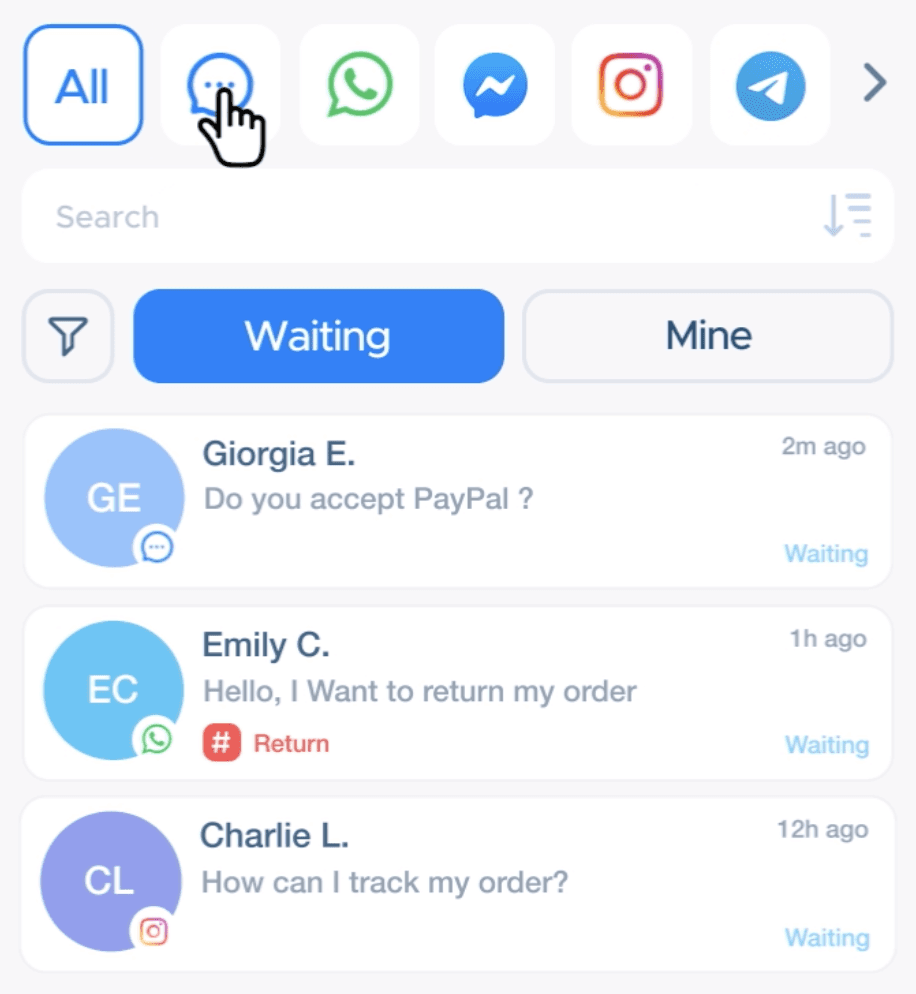
The Qpien Smart Inbox, which gathers all support channels in a centralized interface, completely ends this scattered structure. Trendyol Customer Questions, emails from your website, your WhatsApp Business messages, and social media (Facebook, Instagram) interactions all appear on the screen sequentially and orderly, just as if they came from a single platform. The representative responds to all customers in turn without changing the interface and without distraction. This integrated structure is the most basic formula that enables businesses to increase their support capacity (transaction volume) by more than 50% without increasing the number of personnel.
2. Flawless Experience Thanks to Omnichannel Customer Communication Multichannel selling and providing omnichannel customer communication are two different concepts that are often confused with each other. In multichannel, the brand is everywhere, but the channels operate independently (in silos). In omnichannel, the brand is everywhere, and all channels converse in perfect integration with each other.
The most disturbing situation for a customer is having to explain their problem from the beginning when they switch from one channel to another after explaining it to a representative. Thanks to integrated platforms like Qpien, a customer can start a conversation via email and continue from Instagram if they wish. When the representative clicks on that customer's profile, they see the past chat transcripts from all different channels in chronological order on a single screen (Single Customer View). This feeling of "I know you and I am familiar with the subject" offered to the customer is by far the most effective way to increase customer satisfaction in today's digital world.
3. Conquering Marketplace Algorithms and Catching the Buybox Advantage If you are selling on platforms like Trendyol, Hepsiburada, or Amazon, you know very well that the platform sets the rules. These platforms operate with the philosophy that "The customer is always right and cannot be kept waiting." A seller who answers a customer's question like "What are the product dimensions?" or "Which shipping company do you use?" in 15 minutes and a seller who answers after 5 hours will never be treated the same.
The algorithms tag stores that respond quickly to questions and resolve complaints instantly as "Reliable Sellers." This tag allows you to rank higher in product search results (SEO), win the Buybox, and be highlighted during special campaign periods offered by the platform. When you centralize your marketplace Q&A management processes via Qpien, every incoming question instantly drops in front of you. If necessary, you can reply in seconds with pre-defined canned responses or the suggestions of the integrated artificial intelligence (AI) assistant. This tremendous speed organically multiplies your sales volume (Revenue) in the marketplace by permanently fixing your store rating at 95% and above.
A "Tabless" Revolution in Order Management with Qpien Integrations
The biggest reason why a customer representative cannot respond quickly is their inability to instantly access the data (Shipping status, order content, stock information) that will answer the customer's question. When the customer says "Where is my cargo?", the representative minimizes the chat screen, enters the e-commerce infrastructure panel (for example, a panel like Shopify, Ticimax, or Ideasoft supported on the Qpien Integrations page), searches for the order number, copies the status, returns to the chat screen and pastes it. This "manual operation" is a process that both has a high margin of error and is frustrating.
Qpien offers deep e-commerce and marketplace integrations that redefine the standards in the e-commerce world. The moment the customer writes to you, the Qpien infrastructure matches information such as the customer's email address or phone number (or marketplace ID) and brings:
All the orders they have placed in the past,
The status of their current active order (Preparing, Shipped, Returned, etc.),
The products they forgot in their cart,
The cargo tracking links, directly to the side panel on the immediate right of the chat window in front of the representative.
Without opening any new tabs or logging into a different site, the representative instantly sees the customer's entire order history. It takes only 3 seconds to give the customer the information "Your order is currently in the packaging stage and will be delivered to the cargo company in the afternoon." Managing customers from a single screen that merges your customer database and your communication tools so smoothly is the very definition of a competitive advantage in the industry.

Turning Marketplace Customers into Loyal Customers of Your Own Website
The biggest disadvantage of selling in marketplaces is the issue of "data ownership." The customer who buys your product from Trendyol is actually not your customer, but Trendyol's customer. The marketplace only gives you the shipping label; most of the time, it hides the customer's real email address or direct phone number. In this ecosystem where commission rates are high, your ultimate goal for a profitable and sustainable growth should be to attract that customer, who made their first purchase from the marketplace, directly to your own website without commission for their next purchase.
So how will you achieve this? The answer: By creating an excellent customer service experience.
When a customer asks a question via the marketplace, if you approach them in a fast, professional, transparent, and helpful manner, you build trust in your brand. With a small discount coupon you put inside the order box (E.g., "15% discount valid on your next purchase on our website") and smooth return/exchange communication, you can direct that customer straight to your own e-commerce site's Live Support or WhatsApp line. Thanks to the Qpien infrastructure, when the customer contacts you directly, it saves them in your own database (CRM), and you become the owner of "First-Party Data." You can now send WhatsApp promotions to this customer via the Qpien Campaign module you set up without paying a marketplace commission, and make sales with high profit margins directly from your own site.
Multichannel Collaboration: Tear Down the "Walls" Between Departments
In large e-commerce operations, "customer service" does not consist of a single person. There is a warehouse team, accounting (billing) team, technical service, and sales representatives. A message coming from marketplaces or the website sometimes requires the joint work of these departments.
In fragmented systems, the customer representative initiates a separate correspondence via WhatsApp or email to ask the warehouse team about the issue, gets information, and returns to the customer. This communication disconnection prolongs the process. In advanced e-commerce helpdesk software, internal team communication takes place directly inside the customer's ticket or chat screen. By tagging @warehousemanager right under the customer's message (with an internal note the customer will not see), the representative can ask, "Is the red color of this product in stock?" The warehouse manager replies on the same screen, and the customer representative gets back to the customer without losing any time. This internal collaboration culture, which tears down the walls between departments, will skyrocket your operational speed.
Conclusion: Take Control of All Channels and Boost Your Growth with Qpien
In the e-commerce and marketplace ecosystem, success no longer comes from producing the best product or selling it at the cheapest price; success is achieved by being present on every channel the customer wants to reach you and welcoming them with a flawless communication process without keeping them waiting, and by knowing them.
If you want to protect your store rating in the ruthlessness of competition in marketplaces, turn visitors on your own e-commerce site into loyal customers, and prevent the burnout your support teams (or yourself) will experience by drowning among screens; you must manage your e-commerce communication processes with a single unified intelligence.
Take action now to consolidate your scattered world of Trendyol, Hepsiburada, Shopify, Ideasoft, WhatsApp, Instagram, and Email under a single powerful roof, and add order, speed, and professionalism to your e-commerce operations. By trying Qpien, where you can integrate all your channels within minutes without experiencing installation difficulties, for 14 days free of charge, carry your brand to the peak of omnichannel communication today! Unleash the communication potential of your business and take full control of your sales into your own hands.